
Compilation of Resources + Discussion Questions from Podcast Episodes
You can find these resources and discussion questions in the show notes of every episode, but we also put them all here in one place for you in case that makes them easier to find.
Episode 1: Safety & Security
In this episode we talk about Safety and Security with our guest, Che Johnson-Long, Community Safety Director at Vision Change Win.
Resources from this episode:
Vision Change Win offers many resources on community safety, including:
Get in Formation Training Series is an intro level training for basic community safety skills around verbal deescalation, event safety and organizational safety.
Organizational Safety Planning Risk Assessment Tool will guide your group through building a risk assessment, the first step in organizational safety planning.
Fascism Barometer podcast by Ejeris Dixon, helps us understand the current political moment which can inform our assessments.
Power and Protect Safety Resource Library - prevention and preparedness resources, and recommendations to help build organizational practices and resilience
Discussion questions to take to your team:
To get a sense of how to make a fear assessment rather than a risk assessment, you can start by asking yourself and your group these two questions:
What is the likelihood of this happening?
What is the impact it might have?
To help discern the likelihood of something happening to your particular organization or community, talk with partners and ask questions like these:
I’m worried about this scary thing happening. Has it happened to you?
I’ve heard about this thing in the news. Have you heard about it at our local level or in our communities/sector?
As you are making assessments around safety and security, regularly pulse check within your group: Are our assessments making us move away from or toward organizations we are in partnership with?
Episode 2: Who We Are: History, Framework, and Origin Stories
In this origins episode, we flipped the script, and guest Denise Perry interviews co-hosts Yashna Maya Padamsee and Sha Grogan-Brown!
Resources from this episode:
Sanctuary Embodied for embodiment and somatics resources (like the centering activity within this episode)
Discussion questions to take to your team:
What lineages do you draw from in your operations work?
Who is a figure who you see as a political and/or operations ancestor?
What is an event in history that you see as a pivotal moment of movement operations? Feel free to reach for the well-known figures and events, or (even better) the lesser known!
What Rad Ops principle do you resonate with the most, and why?
How often do you practice this principle in your work? What is one thing you could do to practice this principle more of the time?
Episode 3: Non-Compliance in an Unjust World
In this episode we talk about Non-Compliance with our guest, Roberto Tijerina, Organizer Journeyman / Popular Educator.
Resources from this episode:
Discussion questions to take to your team before tackling non-compliance:
What is the organizational mission/north star?
Is there political agreement around it?
Is there political agreement around non-compliance?
Have you gamed out consequential scenarios and prepped contingencies?
Episode 4: Human Resources
In this episode we talk about Human Resources with our guest, Tara Shuai Ellison, Founder of Shuai Strategies and co-founder of Rad Ops social media network.
Resources from this episode:
Webinars:
Be Strategic, Not Scared webinar with Tara Shuai Ellison and Kehsi Iman Wilson
Strategies for Equitable Hiring webinar with Tara Shuai Ellison and Kehsi Iman Wilson
Books: Leading for Justice & Supervision Matters (Rita Sever)
Discussion questions to take to your team from the Rad Ops workbook:
If you find yourself pitting concepts against each other, or believing one is more important than the other, it’s time to pause and consider:
How are both sides of the binary existing in contradiction to each other?
How might one side engage with or strengthen the other?
Download Rad Ops workbook (page 21-22) for an activity about False Binaries & Contradictions
Episode 5: Role of Assistants
In this episode we talk about the Role of Assistants (and so much more) with our guest, Felicia Martinez, freelance consultant and co-founder of Rad Ops social media network.
Resources from this episode:
Rad Ops Workbook – Putting Rad Ops into Practice activity (pages 16–20)
Choose and use a tool with teams of two or more people (such as a Director and an Assistant) to discern division of labor and coordination: DARCI/MOCHA/RACI
Discussion questions to take to your team:
What does the Director want and need from the Assistant? What does the organization want and need from the Assistant? Is there alignment between the Director and the organization about what the priorities of the Assistant are? (Principles 4 & 6)
What access does the Assistant have to professional and political development, especially as it relates to their work for this Director? (Principles 1 & 7)
What possibilities does the Assistant have for building relationships across the organization? (Principle 2)
If you don’t have positional power at your organization, do you have positional authority? Do you have a positional view point and discernment that no one else has but could reflect important emerging needs for the organization? (Principle 1)
Episode 6: Resource Mobilization
In this episode we talk about Resource Mobilization with our guest, Allison Budschalow, Consulting Partner at Dragonfly Partners, Co-facilitator at Securing the Roots, and co-host of the podcast Movement Money.
Resources from this episode:
The team at Dragonfly Partners takes a 360-degree approach to support the work of resource mobilizers, including assessing our most valuable resources—our relationships with one another through:
In It Together—a toolkit and workshop that helps movement-building groups navigate conflict, strengthen accountability, and work together in healthier, principled ways.
When We Fall Apart—a workbook and workshop to provide social justice groups with a vital framework for navigating necessary organizational and group breakups with integrity and intention.
Movement Money episodes on Organize the Rich Radio
Peer connection: Radical Fundraisers Network
Books:
Ella Baker & the Black Freedom Movement by Barbara Ransby
Free the People to Free the Money to Free the People, Edited by: Michael Gast, Marian Moore & Alex T. Tom
Organizations:
Discussion questions to take to your team:
What is your 30 year vision—for yourself? For your group, organization, community, people? What will become possible by being honest — with yourself, philanthropy, donors — about what you or your organization or your movement needs to get closer to your vision?
What is your relationship to the middle class? What do you think the relationship is for the middle class to the millionaires in our communities?
It’s 2051, and a 21 year-old in your life is asking you about the most valuable resource/s in your life. What will you say?
When you connect with your most honest parts, what do you want to tell
a) people who have access to land, wealth, and money?
b) people without access to land, wealth, and money?
How will what you tell them get you and our collective movements (organizations, coalitions, neighborhoods, communities, families) closer to freedom?
How does it feel to think about these questions?
Episode 7: Culture of Care
In this episode we talk about Culture of Care with our guest, Adaku Utah, Director of Movement Building Programs at the Building Movement Project.
Resources from this episode:
How to Build Solidarity Infrastructure for the Long Haul by Adaku Utah and Deepa Iyer
Stories for Power Podcast: Durham | creative interventions
Communities of Care article by Yashna Maya Padamsee
Transforming Our Organizations, Transforming Ourselves article by Sha Grogan-Brown
Book: The Future is Collective: Effective Workplace Strategies for Building a Culture of Care by Niloufar Khonsari
Get 25% off with the code RADOPS when you place your order
Discussion questions to take to your team:
How is your organization defining and directing care?
Where do you see a gap between what your organization values and cares about publicly and how things actually function internally in your organization, and what would it take to close that gap in practice?
What boundaries would make care more durable for you and others ?
What contradictions around care are most alive in your work right now? What does it reveal about where your organization needs to grow?
What season is your organization in? (Summer, Spring, Autumn or Winter)
Episode 8: Life Cycle of Organizations
In this closing episode of season one, we take on the tough topic of the Life Cycle of Organizations with our guest, Raquel Laviña, Consultant, most recently with the Grassroots Power Project.
Resources from this episode:
Transforming Our Organizations, Transforming Ourselves article by Sha Grogan-Brown contains many links to resources that can support organizational culture shifts
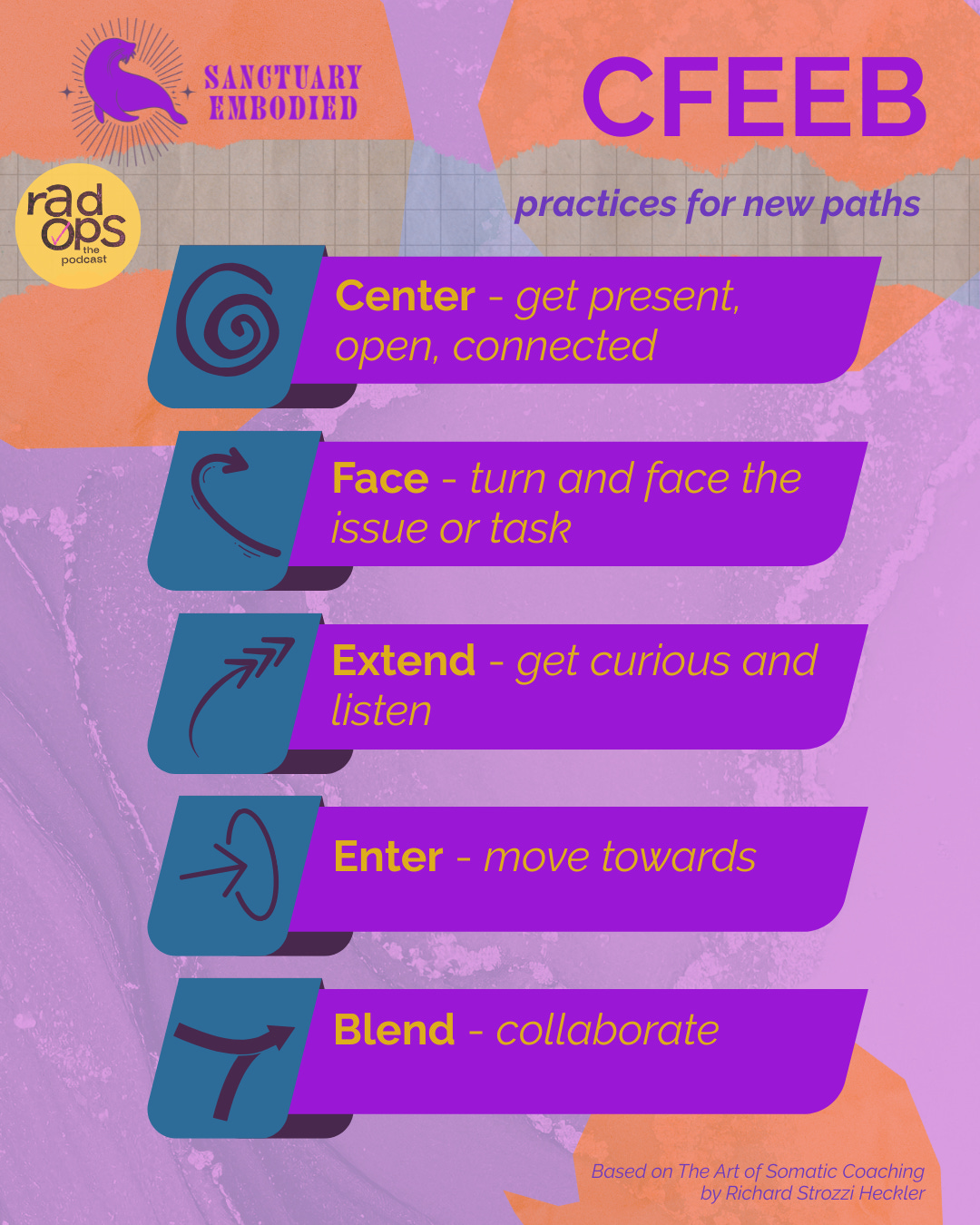
When you are leading with other people, try out this somatic practice called CFEEB (Center, Face, Extend, Enter, Blend) together
Rad Ops Workbook - try out these activities with your colleagues
Visit the Rad Ops Resources page
Discussion questions to take to your team:
Questions for our Organizations
How does the purpose of this organization need to pivot under the conditions of rising authoritarianism?
Is this organization we built in previous conditions still the one that is needed in this current moment?
If many organizations may not make it through this period of rising authoritarianism, how can we clearly assess the unique purpose of this organization?
What are the new formations we might need for the times ahead, beyond our current organizations?
How can the Rad Ops principles inform our collective understanding of what our organization can and cannot do?
How can resilient relationships be baked into organizational structures so we are not relying on individual mastery, or set back due to transitions?
Questions for Ourselves
Can I be okay with what my organization can and cannot put in place?
How can I ensure my relationships outlast current organizational structures?
How can I use the qualities that I’ve learned of starting, stewarding, pivoting, sunsetting in our movement building, even if my organization doesn’t make it?
What will I need in order to sustain myself through whatever transitions are ahead?
Dear Rad Ops
Dear Rad Ops is a mini series advice vlog about live questions on the minds of movement operations workers.
Episode 1: Why Rad Ops?
In this introductory episode, co-hosts Yashna Maya Padamsee and Sha Grogan-Brown discuss their own Rad Ops movement operations experience, and the lineages they draw from in their work to run liberatory organizations in an unjust world.
Resources from this episode:
Explore the Rad Ops Resources page
Rad Ops Workbook - Lineages activity, Spectrogram activity
Discussion questions to take to your team
What lineages do you draw from in your operations work?
Who is a figure who you see as a political and/or operations ancestor?
What is an event in history that you see as a pivotal moment of movement operations? Feel free to reach for the well-known figures and events, or (even better) the lesser known!
How has your identity and your relationship to Operations work changed over time?
When and where did you get politicized? What political formations have you been a part of? How have they shaped what you think about operations right now?
The definition we have for Rad Ops is: Rad Ops is short for Radical Operations, and it’s about running liberatory organizations in an unjust world. Finding the ways that we can be liberatory with each other while we navigate the constraints of racialized gendered capitalism, heteropatriarchy and rising fascism. Do you practice Rad Ops at your org? Where are you already doing this? Where are places at your org that you want to bring a Rad Ops approach?
Episode 2: Multi-Entity Infrastructure
In this episode, Sha Grogan-Brown talks with guest Le Tim Ly, Chief Operating Officer of Center for Empowered Politics about how building “multi-entity infrastructure” can improve the resilience of organizations.
Resources from this episode:
Definition List of types of organizational entities
Definition List of organizational entities
Organizations providing support for exploring multi-entity infrastructure:
Power & Protect Operations Network (check the resource library too)
New Left Accelerator (check the resource page too)
Want to go deeper on the difference between 501c3, 501c4 and PAC? Listen to this episode of Rules of the Game podcast, comparing tax-exempt organizations
Discussion questions to take to your team:
What entities currently make up your organization’s infrastructure? Is everyone on staff aware of the reason or purpose for each of those entities?
If you have a 501c3 organization, what is your back up plan in the case of losing your tax status? (Be sure to check out the next episode on risk assessment vs fear assessments, and be mindful of reacting to this question primarily based on fear…)
Which parts of your work could happen via a different entity?
Episode 3: Fear vs Risk Assessments
In this episode, Yashna Maya Padamsee talks with guest Che Johnson-Long, Community Safety Director at Vision Change Win, about how we can be making grounded risk assessments in these times of escalated fear.
Resources from this episode:
Vision Change Win offers many resources on community safety, including:
Get in Formation Training Series is an intro level training for basic community safety skills around verbal deescalation, event safety and organizational safety.
Organizational Safety Planning Risk Assessment Tool will guide your group through building a risk assessment, the first step in organizational safety planning.
Safety Recommendations from Sept 2025 can help you understand where to prioritize if you’re not sure where to start.
Fascism Barometer podcast by Ejeris Dixon, helps us understand the current political moment which can inform our assessments.
Discussion questions to take to your team:
To get a sense of how to make a fear assessment rather than a risk assessment, you can start by asking yourself and your group these two questions:
What is the likelihood of this happening?
What is the impact it might have?
To help discern the likelihood of something happening to your particular organization or community, talk with partners and ask questions like these:
I’m worried about this scary thing happening. Has it happened to you?
I’ve heard about this thing in the news. Have you heard about it at our local level or in our communities/sector?
As you are making assessments around safety and security, regularly pulse check within your group: Are our assessments making us move away from or toward organizations we are in partnership with?
Episode 4: Pivoting Budgets
In this episode, Sha Grogan-Brown talks with guest Nat Smith, Finance & Development Director with House of gg and facilitator with A Bookkeeping Cooperative to offer advice to organizations needing to make major pivots to their budgets.
Resources from this episode:
Take a training with A Bookkeeping Cooperative - engage in conversation and take home tools
If you really don’t have time to take a training and need something quickly, you could try out this Nonprofit Budgeting Scenario Planning Tool from Nonprofit Finance Fund:
National Council of Nonprofits has a lot of free resources on their website, in particular in the Budgeting for Nonprofits section and this 10 step budgeting checklist.
Lastly, Nat recommends you check with current funders about what resources they have to support you in this process. They may be quick to recommend and/or share packets or tools they have.
Discussion questions to take to your team:
Before reviewing the budget together, discuss these questions:
Based on the current conditions of our work, what are our hopes and dreams for this organization’s mission?
What are the top 3 values we want to lean into during this time? Which aspects of our work will best support us to meet those values?
What are the commitments we have made to our constituency? Which aspects of our work will best meet those commitments?
Which aspects of our hopes and dreams for our organization do we not have the capacity to take on during this phase of our work?
Based on the discussion of the questions above, what are the 2 scenarios that we should consider for revising our budget? Nat encourages us to frame this scenario planning as Alternative Futures work.
Once you identify the 2 scenarios, use the budgeting scenario planning tool.